Solutions / Ransomware
Rules for the stages before encryption
AEGIS production rules cover the steps a ransomware operation takes before it encrypts. Your endpoint tool isolates the host once the request is approved.

Encryption is the last step
By the time files are encrypted, the intruder has usually signed in with a stolen account, collected credentials, moved between hosts, switched off defences and copied data out. Each of those steps leaves events in logs you already collect.
AEGIS works from those logs. When a production rule matches, it raises an alert, joins related alerts into one incident, and puts a containment action in front of the right people with the evidence attached.
Rules and analytics for each stage
Each technique is named by a rule in production.
| Stage | ATT&CK techniques | Other mechanisms, at any stage |
|---|---|---|
| Entry | T1566.001 spearphishing attachment, T1204.002 malicious file, T1078 valid accounts, T1110 brute force | Identity analytics on sign-in events; scoring of reported phishing messages |
| Credential theft | T1003.001 LSASS memory, T1003.002 security account manager, T1003.003 NTDS | Signal clusters: weak signals for one entity that add up inside a set window |
| Lateral movement | T1021.001 remote desktop, T1021.002 SMB and admin shares, T1550.002 pass the hash, T1569.002 service execution | Correlation sequences: ordered stages within a window, grouped by an entity |
| Defence evasion | T1562.001 disable or modify tools, T1070.001 clearing of event logs | Grouping: alerts on one host join one incident |
| Command and control | T1071.001 web protocols, T1071.004 DNS, T1105 ingress tool transfer | Beaconing: regular-interval connections from a host to a domain |
| Exfiltration | T1560.001 archive via utility, T1048 exfiltration over alternative protocol, T1567.002 exfiltration to cloud storage | UEBA: per-user volume against that user's baseline |
| Impact | T1490 inhibit system recovery, T1486 data encrypted for impact, T1485 data destruction | Entity risk: each alert adds decaying risk to the host and account it names |
The ATT&CK Coverage page shows, for each technique, whether an alert carrying it has been raised in your deployment and whether a rule fired on a lab recording.
rules in production, each tested against a record that must alert and one that must not.
ATT&CK technique IDs named by those rules.
playbooks ship, among them Contain Compromised Host and IOC Sweep.
From the first alert to a contained host
Group
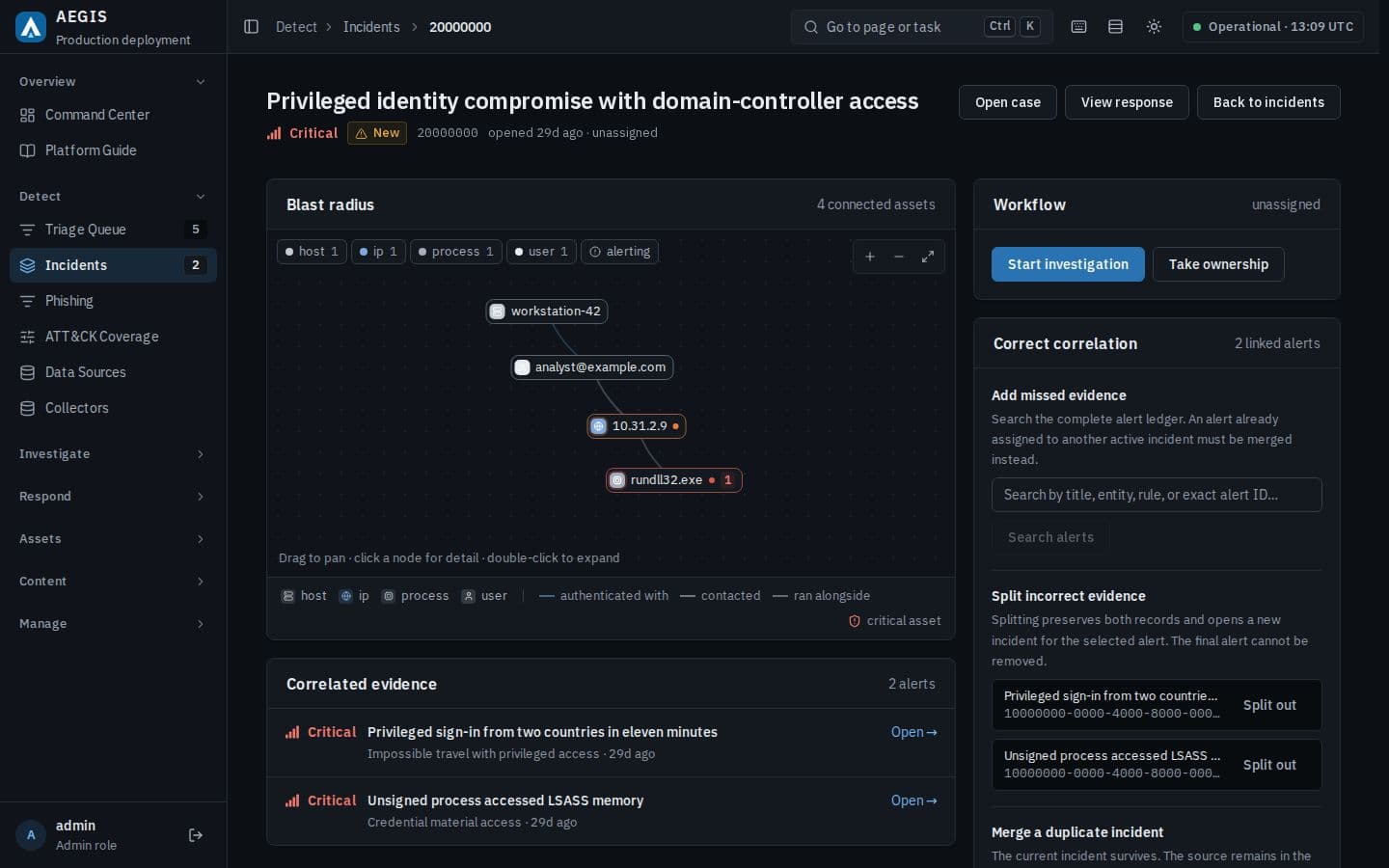
Alerts that share a host or an account within 10 minutes join one incident. The incident page shows the blast radius, the grouped evidence and why each alert belongs.
Investigate
The AI analyst investigates with read-only tools and quotes its evidence. For a true positive it may request one containment action on one of the alert's entities.
Approve
In the shipped policy, isolating a host above severity 3 needs an analyst and then a different administrator. An approval at severity 4 or above is announced to chat and paging.
Contain
AEGIS sends the isolation as a signed webhook to your own automation, and your endpoint tool carries it out.
Record
The case keeps the timeline, the evidence and the response clock. The action ledger marks each action dry run, simulated or live.
Around the incident
Paths to the assets you marked critical
The entity graph records observed relationships between users, hosts, addresses, domains and processes, and shows the paths from an entity to your critical assets.
Hunts that run on a schedule
Three SQL hunts ship, among them one for rare external domains contacted repeatedly over 7 days. A hit opens a case.
One switch stops automated response
The halt switch covers the whole deployment. It is read when a request is evaluated and again immediately before the connector is called.
Incident
An incident is drawn as a graph of the hosts, accounts and addresses its alerts name. Read it before choosing which host to isolate.
Common questions
What if nobody answers the approval?
An approval at severity 4 or above still undecided halfway through its window is escalated once. At 30 minutes the action is rejected and the expiry is written to the audit log.
Can we block an address without a firewall integration?
Yes. A live block writes a 24-hour entry to the tenant's block list, which firewalls poll as a plain-text list with a dedicated key. It needs no response connector.
Can we rehearse the playbook on a real incident?
Yes. Every action runs as a drill, recorded with nothing changed, until you enable live response. Requests from the AI and from playbooks are dry runs by default.
Read next.
- DetectionAEGIS 0.3.4 has 132 rules in production, beside analytics for behaviour, beaconing and identity.
- ResponseAEGIS can isolate a host, disable a user, block an address or quarantine an email.
- Account takeoverAEGIS flags a stolen account by where a sign-in came from, what came just before it and what the account normally does.
Talk to an engineer
Tell us what you run today and what worries you. Someone who works on AEGIS will reply.
Get in touch