Solutions / Evidence for an audit
An audit log your examiner can recompute
AEGIS records each security-relevant change and approval in an audit log your examiner can verify. You hand over the log, approvals, access reviews and cases as exports.

Who acted, who approved, what changed
An examiner asks who took an action and when, whether a different person approved it, and whether anyone could have changed the record since.
An ordinary log answers the first two, provided you trust the log. AEGIS answers the third as well: each tenant's audit log is a hash chain, the database refuses edits to it, and a signed checkpoint of the chain is written to storage outside the server. The Audit Chain page recomputes the chain and checks the last day of checkpoints.
What the log covers
| Area | Recorded | Detail an auditor will want |
|---|---|---|
| Alerts and cases | Changes to alerts, incidents, risk and cases | Every closure names who made it: ai, human or rule. |
| Response | Approvals and actions | An approval left undecided for 30 minutes is rejected and recorded as expired. |
| Detection content | Tuning, exceptions and rule lifecycle moves | An exception carries a reason, an owner and an expiry of at most 90 days. |
| Data paths | Connectors, parsers, export destinations and keys | A tenant parser is saved when every sample passes, and the save is audited. |
| Access | Successful sign-ins, two-step sign-in and provisioning | Each access-review export is itself an audit record. |
| AI | Changes to AI settings | Each investigation also stores its workflow version and the model whose answer became the verdict. |
| Halt switch | Changes to the deployment-wide stop for automated response | While it is on, every action request is refused and recorded. |
| Queries | A SHA-256 hash of the SQL that ran | The hash enters the log; the query text does not. |
| Tenants | Tenant lifecycle | A purge leaves a completion record and a verification pass. |
What you can hand over
The audit log, as a file
The Audit Chain view exports its full filtered collection as an XLSX workbook or JSON.
An access review on demand
Accounts with their role, two-step sign-in state and last sign-in, as CSV or JSON.
A whole case in one package
The escalation package is a read-only bundle of a case's alerts, verdicts, citations, entities, actions and notes, for hand-off or printing.
Approvals and the action ledger
The Response view exports with its filters applied. The ledger marks each executed action Dry run, Simulated or Live and shows where it went.
Technique coverage in three states
ATT&CK coverage exports as a Navigator layer that keeps declared, observed and validated apart.
A copy in your own log system
A tenant admin can send the tenant's alerts and, optionally, its audit records to up to 10 destinations, as syslog over TLS in CEF, LEEF or JSON.
Artefacts of the release itself
Each release carries a software bill of materials for every image, and the weekly restore drill writes its own report.
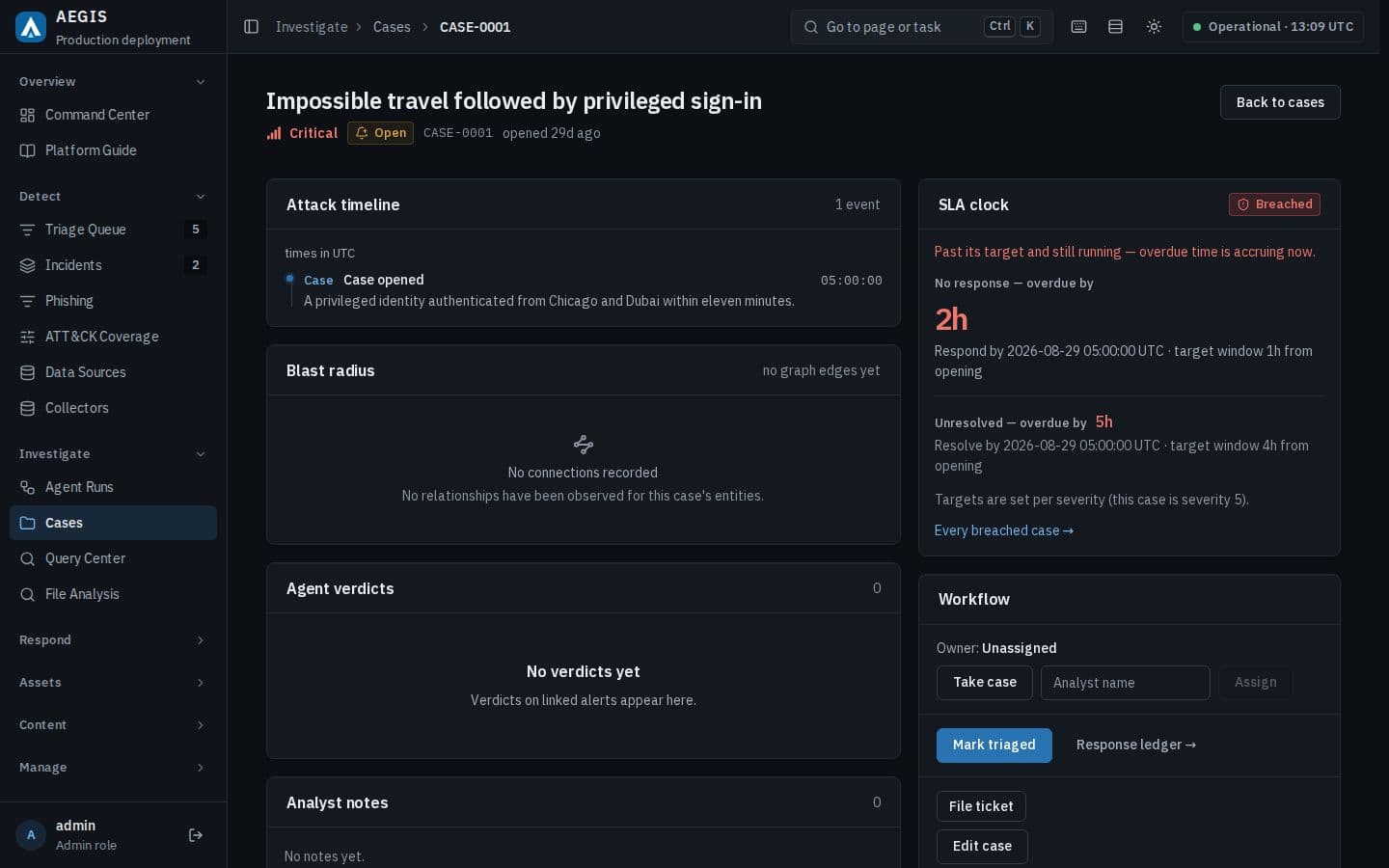
Case
A case holds its timeline and its evidence on one page. An examiner reading it follows the incident in the order it happened.
Common questions
Does the AI analyst's work appear in the record?
Yes. Each investigation keeps its steps and its citations.
How do we show that two people approved an action?
A requester cannot approve their own action, and each approval is an audit record. In the shipped policy, isolating a host above severity 3 and every account disable need an analyst and then a different administrator.
How long is the record kept?
Audit records, alerts, incidents, cases and investigations are kept until the tenant is purged. Checkpoints outside the server are retained 400 days by default under an object lock.
Who reads the audit log?
Auditors read the per-tenant log, verify it against the signed checkpoints and export access reviews. Four roles, viewer, analyst, admin and platform, are checked on every request.
Read next.
Talk to an engineer
Tell us what you run today and what worries you. Someone who works on AEGIS will reply.
Get in touch