Platform / Case management
One case per incident
AEGIS opens a case when an alert is a true positive or is escalated. It holds the timeline, the linked alerts, their verdicts and the notes.
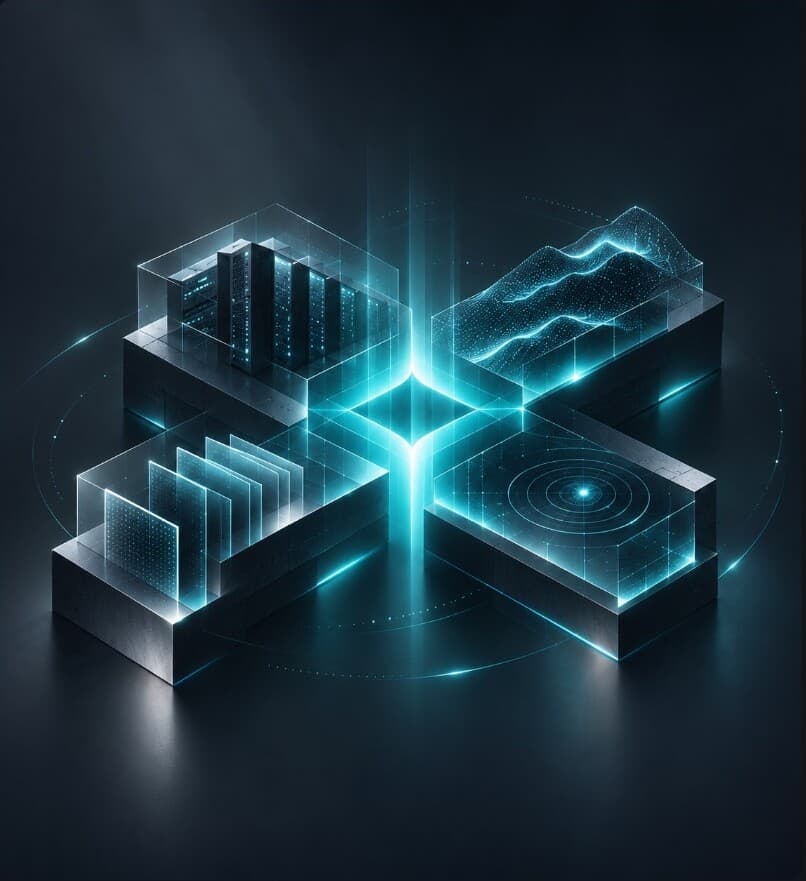
What opens a case
AEGIS keeps the work of an investigation on the case. A true positive or an escalation opens one automatically, a scheduled hunt that finds a hit opens one, and an analyst can open one by hand.
When an alert's incident already has an open case, the alert is linked to that case and the case takes the higher severity.
Case
The timeline of a case and the evidence gathered so far, as the analyst working it sees them.
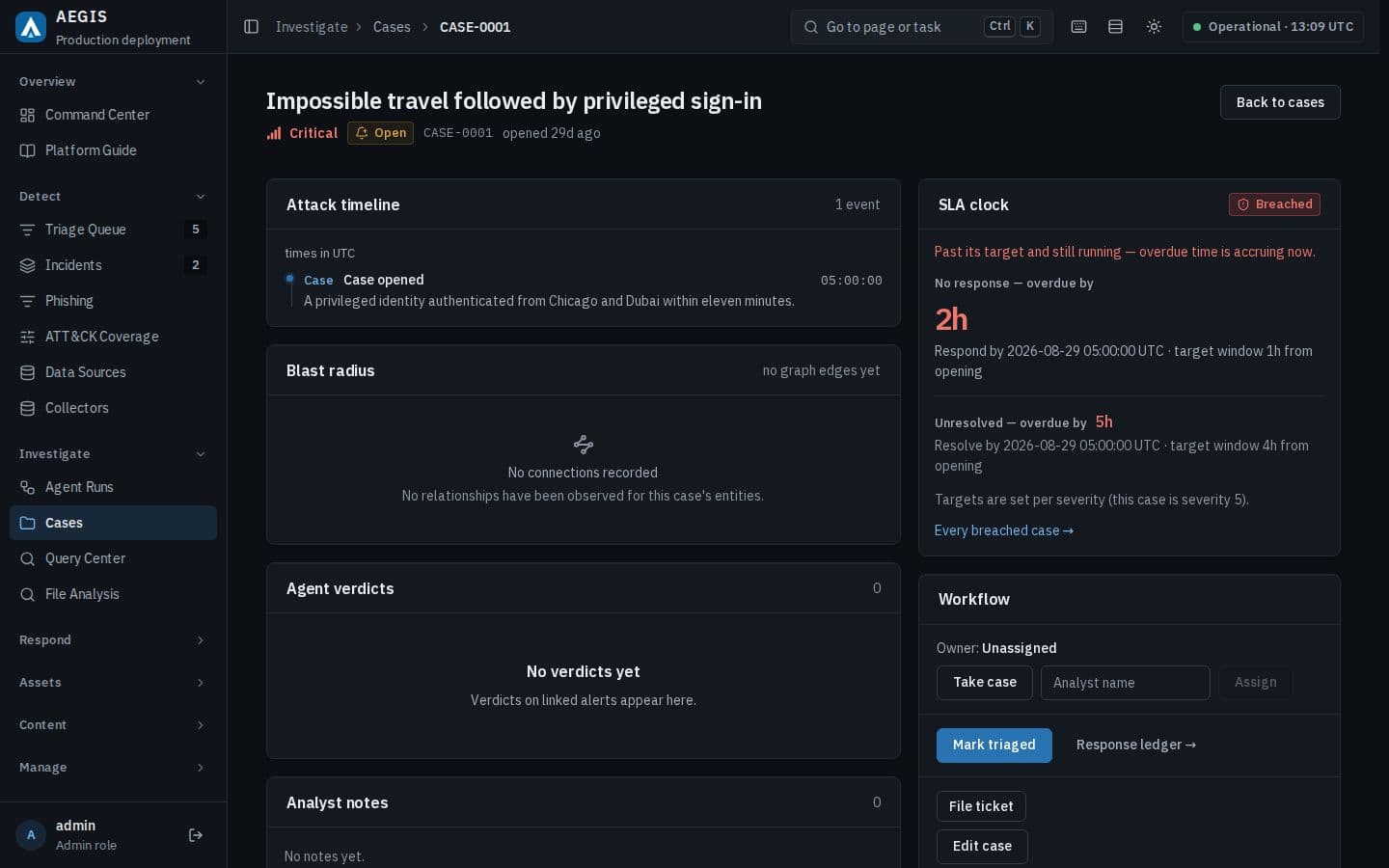
What the case page gathers
The timeline and the linked alerts
With the verdict on each alert, the blast radius, the analysts' notes and the case's custody trail.
Similar past cases
Found by vector search. The embeddings come from a local embedding model by default.
A board and a work queue
The Cases board has Open, Investigating and Closed lanes. A Work queue view shows ownership and deadlines, and the command palette opens a case by its reference.
From open to closed
Open
The case opens and its alerts are linked.
Clock
The case carries a target to respond and a target to resolve, set by its severity.
Work
The case moves from new to triaged to in progress, while analysts write notes and alerts are linked.
Resolve
It ends resolved or escalated.
Close
A closed case cannot reopen. If the threat returns, a new case opens and is linked to the old one.
How a case leaves AEGIS
| Route | What it carries | Form |
|---|---|---|
| Escalation package | The case's alerts, verdicts, citations, entities, actions and notes | A read-only bundle, for hand-off or printing |
| Ticket | The case, sent to Jira or ServiceNow on demand | Configured once for the deployment |
| Export | The full filtered collection of cases | A spreadsheet workbook or JSON |
| Clock message | A respond or resolve clock at risk, or breached | A console toast, and a chat or email message |
| Audit record | Case changes, and each clock at risk or breached | An entry in the tenant's hash-chained audit log |
| Audit export | Optionally, the tenant's audit records, to as many as 10 destinations | Syslog over TLS by default, with CEF, LEEF or JSON bodies |
Respond and resolve clocks
Each tenant can override the respond and resolve targets, and the readiness script checks that they are set.
A clock message goes out when a clock is at risk, and again when it is breached. By default chat, paging and email apply to High and Critical cases. The case queue has a Breached filter.
Those messages leave through a durable outbox. A message is retried for about 40 minutes, and a final failure is written to the audit log.
Common questions
What happens when the AI analyst returns no valid verdict?
The alert is escalated, and an escalation opens a case.
Can one case cover several alerts?
Yes. An incident groups up to 15 related alerts, and they share its case.
How long is a case kept?
Until the tenant is purged. Cases, alerts, incidents, investigations and audit records share that rule.
Read next.
Talk to an engineer
Tell us what you run today and what worries you. Someone who works on AEGIS will reply.
Get in touch