• HomeTutior
  • AEGISPlatform
  • How it worksPlatform
  • DeploymentPlatform
  • CollectionPlatform
  • DetectionPlatform
  • AI analystPlatform
  • Triage and incidentsPlatform
  • Case managementPlatform
  • ResponsePlatform
  • Threat intelligencePlatform
  • ReportingPlatform
  • Audit recordPlatform
  • Access controlPlatform
  • Data handlingPlatform
  • How it is builtPlatform
  • The consolePlatform
  • Product tourPlatform
  • IntegrationsPlatform
  • SecurityPlatform
  • Too many alertsSolutions
  • Too few analystsSolutions
  • Data that must staySolutions
  • Evidence for an auditSolutions
  • RansomwareSolutions
  • Account takeoverSolutions
  • TelecomSolutions
  • BankingSolutions
  • GovernmentSolutions
  • TestingServices
  • OperationsServices
  • CompareResources
  • Against a traditional SIEMResources
  • Against a cloud SOC platformResources
  • Against separate toolsResources
  • Why self-hostedResources
  • Moving from a SIEMResources
  • ExplainersResources
  • What a SIEM isResources
  • SIEM, SOAR and XDRResources
  • What OCSF isResources
  • What Sigma rules areResources
  • ATT&CK, explainedResources
  • What self-hosted meansResources
  • A buyer's checklistResources
  • CompanyCompany
  • ContactCompany
Menu

AEGIS · On-premises security operations

Run your security operations on your own server, with an AI analyst built in.

AEGIS collects your logs, detects attacks and investigates the alerts with an AI analyst, all on one machine you control. Tutior also runs penetration tests and provides SOC analysts.

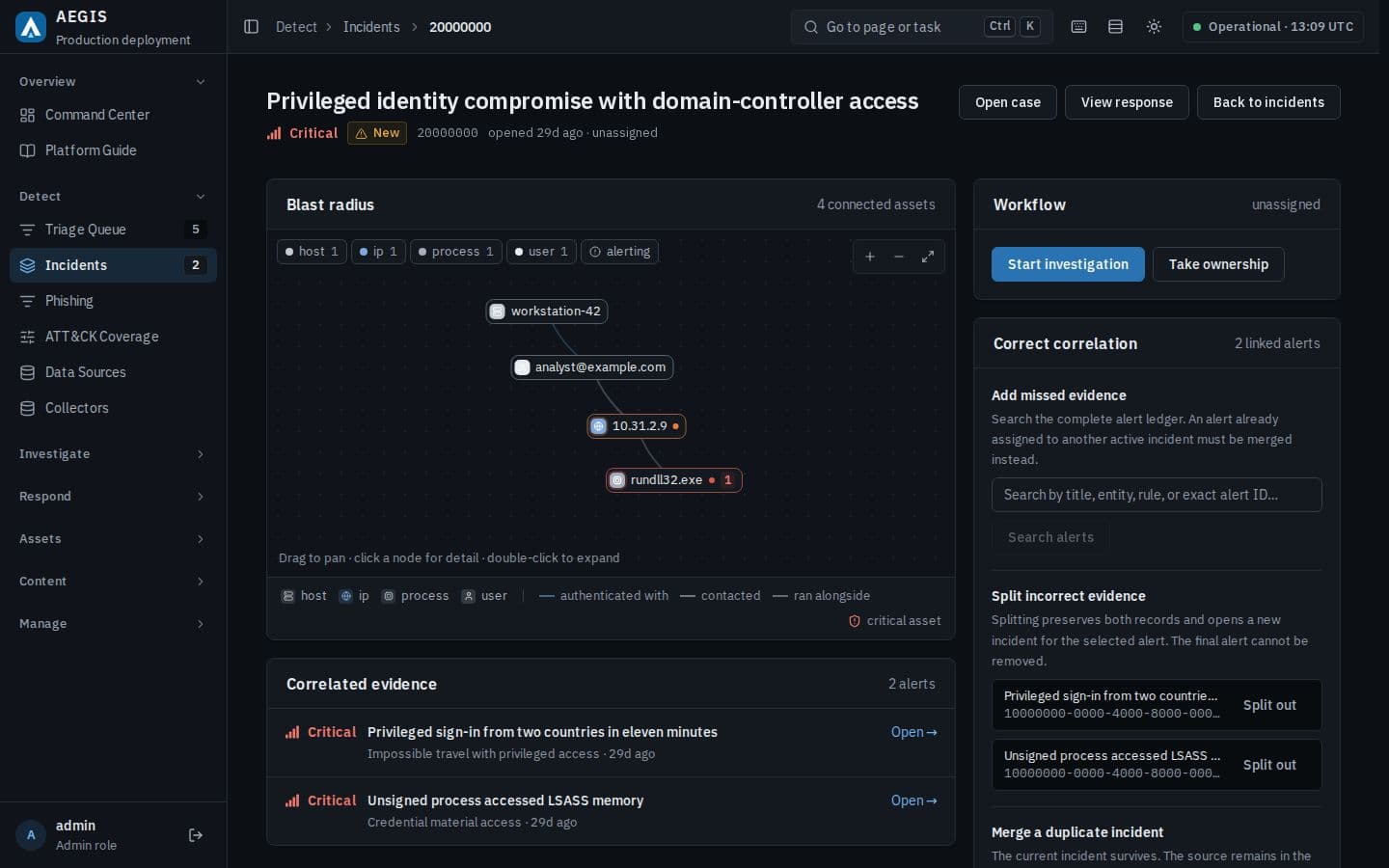
The AEGIS incident view: the hosts, accounts and addresses one attack touched, drawn as a graph.
Incident: who and what an attack touched

01 / The problem

The alerts your analysts never reach

2,992

alerts reach the average security team every day.

63%

of them are never looked at.

46%

of alerts turn out to be false alarms.

02 / The platform

From raw logs to a closed case

Collect

Firewalls, servers, identity, cloud and endpoint tools all feed one place. Events are stored in OCSF, an open format that other tools can read.

85connectors

Detect

Sigma rules run the moment an event arrives, each mapped to an ATT&CK technique. Behaviour analytics watch what rules miss: impossible travel, password spraying, beaconing, dormant accounts waking up.

93ATT&CK techniques

Investigate

The AI analyst investigates the alert with tools that can only read, and returns a verdict that quotes its evidence word for word. When it is unsure, the alert goes to a person.
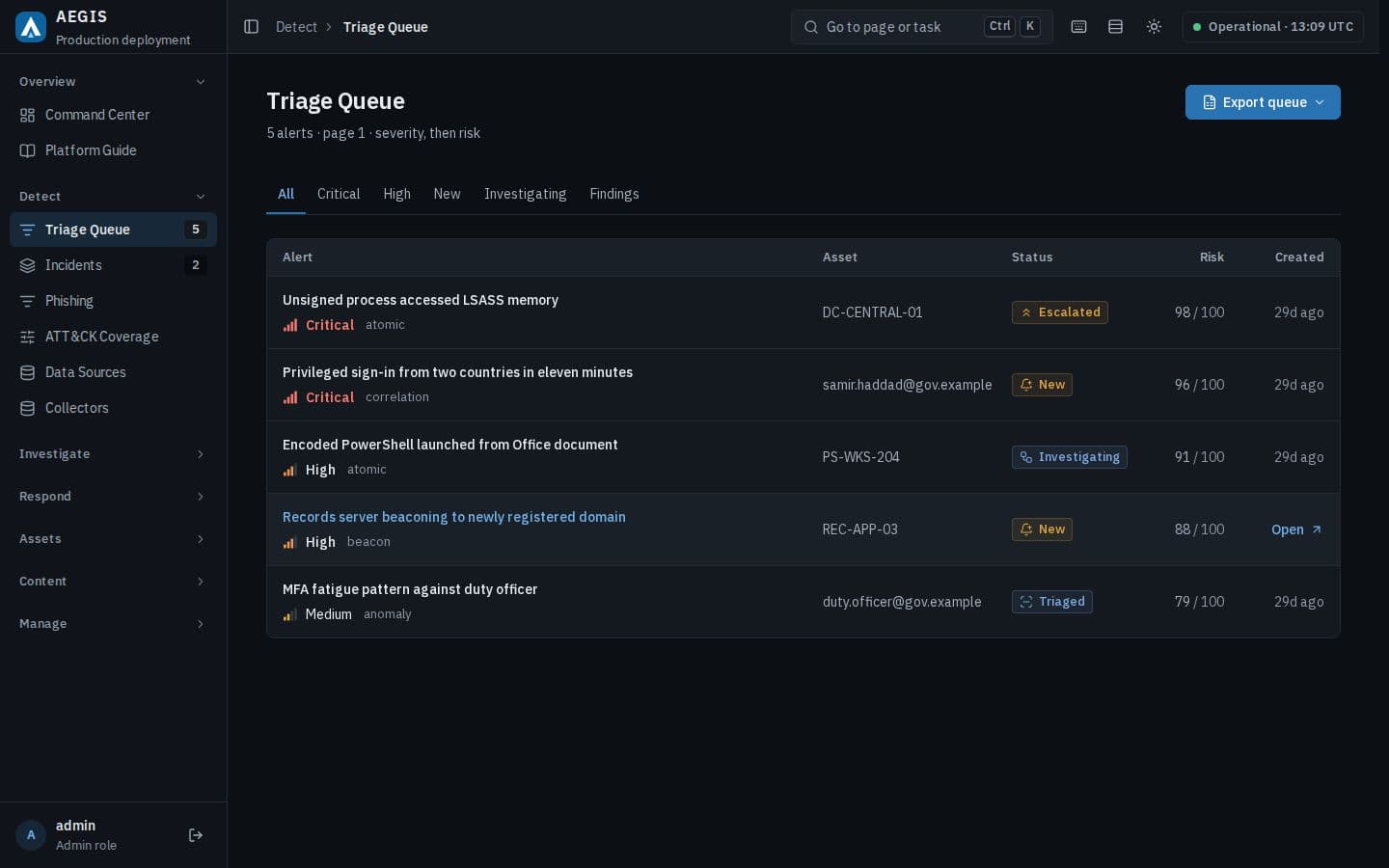
The AEGIS triage queue: alerts with their severity, the asset involved, status and risk score.
Triage Queue: severity, risk and status for every alert

Respond

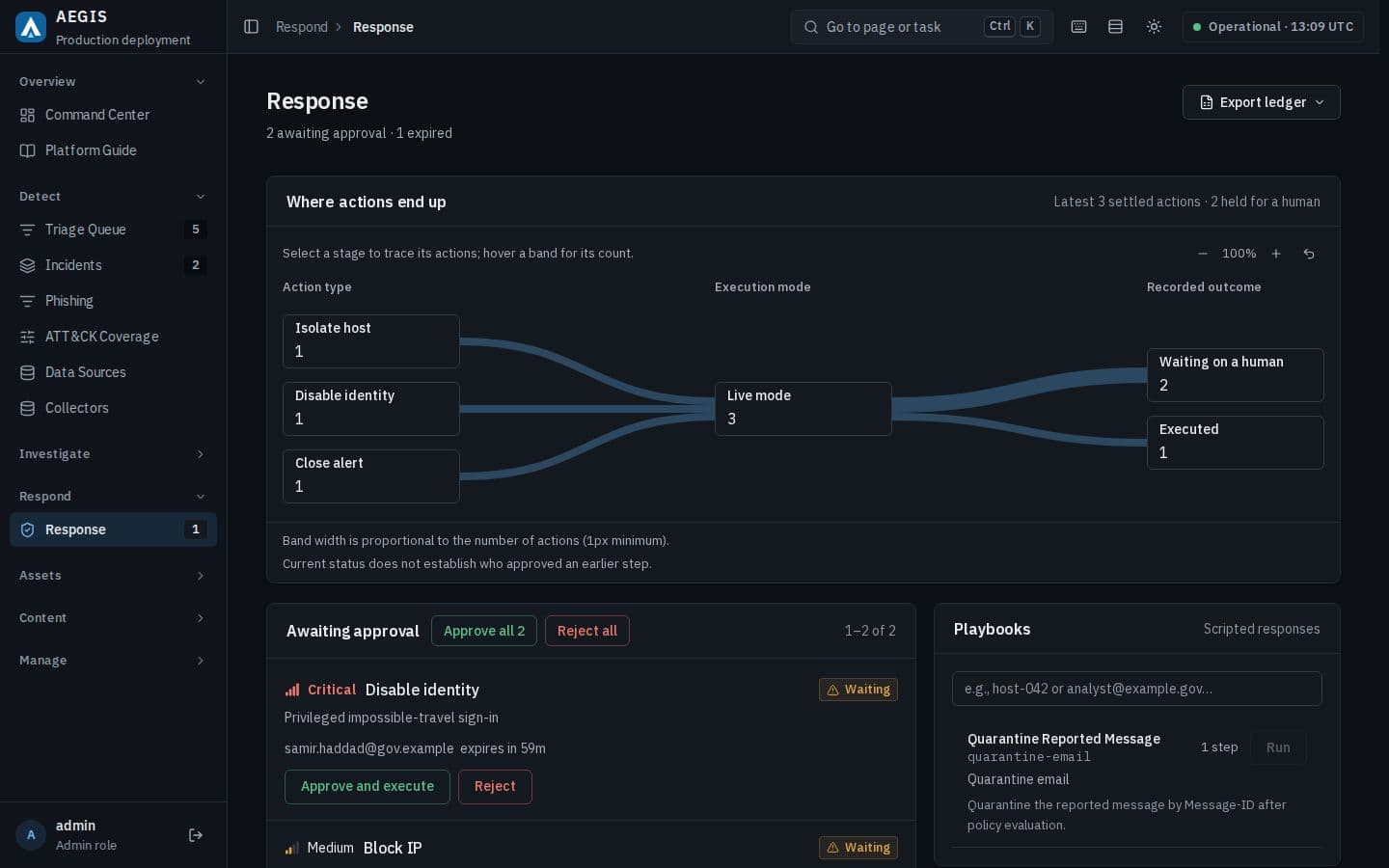
Isolate a host, disable an account or block an address through the tools you already run. An action runs as a simulation until you switch it to live.
6playbooks2people for a critical action
The AEGIS response view: actions flowing from their type to their outcome.
Response: what ran, and what is waiting for approval

Record

What people and the AI do is written to an audit log built so that tampering shows. Each case keeps its timeline, its evidence and its deadlines.
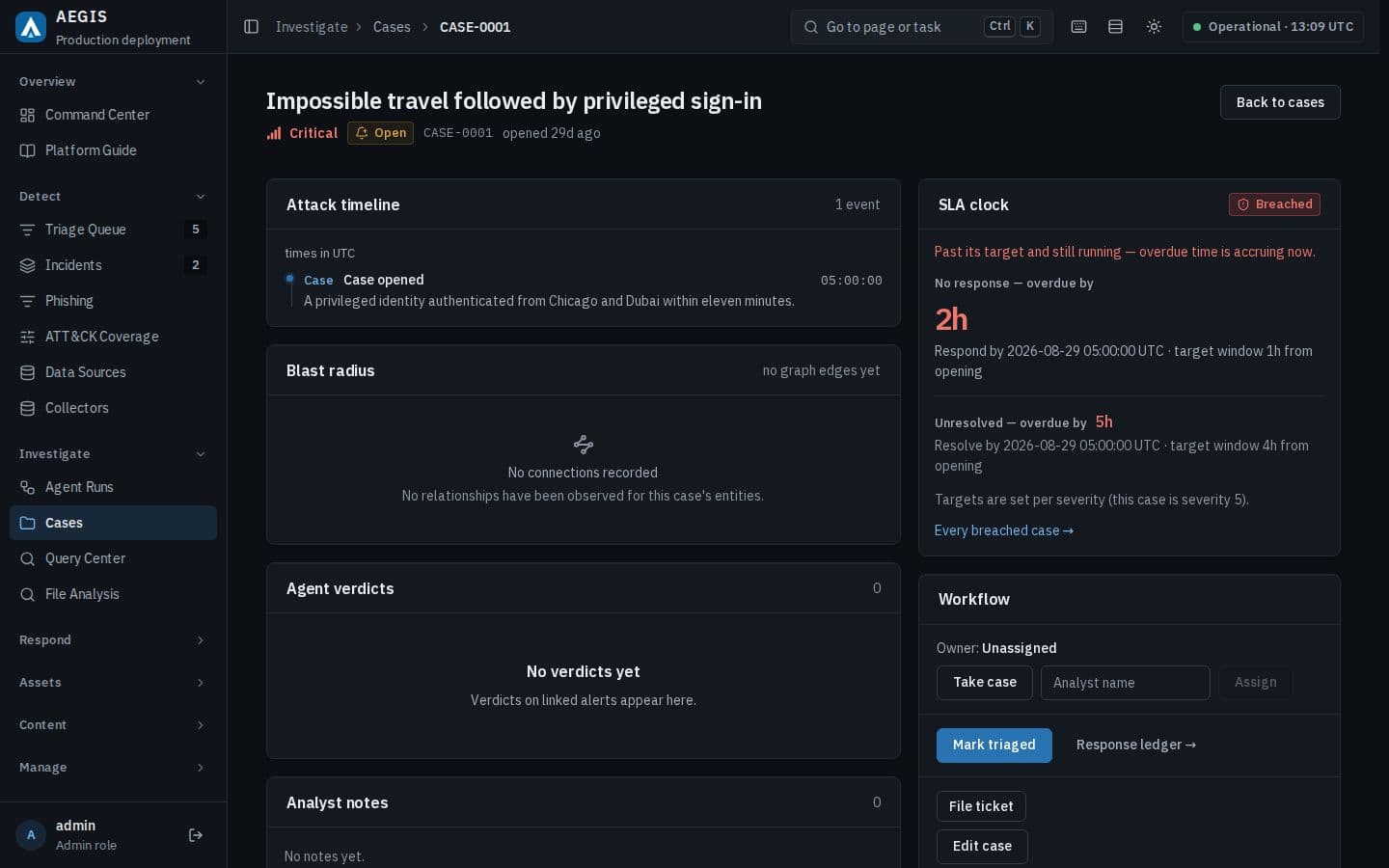
An AEGIS case: the attack timeline and the evidence gathered so far.
Case: timeline, evidence and ownership

03 / Measured

0.26s

from an event arriving to its alert, at 5,000 events a second.

99th percentile, one 16-vCPU server, October 2026
Event arrivesAlert raised

04 / Where your data is

What stays in your hands

Your serverAEGIS is installed in your data centre from one signed bundle.
Your AI modelThe model that investigates your alerts ships in the same bundle and runs on the same machine. It sends nothing out.
Your networkEvents and the console come in on port 443; syslog and host collectors use their own ports once you turn them on. Backups and audit checkpoints go to a store you choose, which can sit on your private network.
Your keysBackups are encrypted with a key that is kept off the server.

Rules on where data is kept and how long

Saudi Central Bank, Cyber Security Framework3.4.3Cloud services need approval first and, in principle, must be in the Kingdom.
Saudi National Cybersecurity Authority, ECC-2:20242-12-3Security events are collected, monitored continuously and kept for at least twelve months.
Central Bank of the UAE, Outsourcing RegulationArticle 6.1The master system of record, with all confidential data, is stored in the UAE.
Qatar Central Bank, Cloud Computing Regulation21.4Personal and financial information is processed within Qatar only.

AEGIS keeps events on your server, and you set how long they stay searchable, from days to years. Our engineers can go through each rule with your compliance team.

05 / Services

Testing

Our testers attack your applications and the servers behind them, then show you each way in and how to close it.

Penetration testing

Operations

Tutior analysts work your alert queue with your team, on your own AEGIS.

Analysts for your SOC

06 / Questions

Common questions

Does the AI send our data anywhere?

No, unless you choose to connect a hosted model in place of the one that ships with AEGIS.

Can the AI act on its own?

It can close an alert of Medium severity or lower that it is confident is harmless, and a sample of those closures comes to your team for review. It cannot change your systems. It can ask for a response action, which then needs your policy and your approvals.

Will it work with what we already run?

It reads from Windows and Linux, Palo Alto, Fortinet and Cisco firewalls, CrowdStrike Falcon, Okta, Microsoft 365 and Entra, the audit logs of AWS, Azure and Google Cloud, Zeek and Suricata, and more.

Who installs and runs it?

Your team installs it from a signed bundle, with our engineers alongside. If you want analysts too, ours join you on the same system.

Talk to an engineer

Tell us what you run today and what worries you. Someone who works on AEGIS will reply.

Get in touch