Compare / Against a traditional SIEM
AEGIS and a traditional SIEM
AEGIS does the work of a SIEM and carries on after the alert: the AI analyst investigates the alerts, true positives open cases and response waits behind a policy gate.
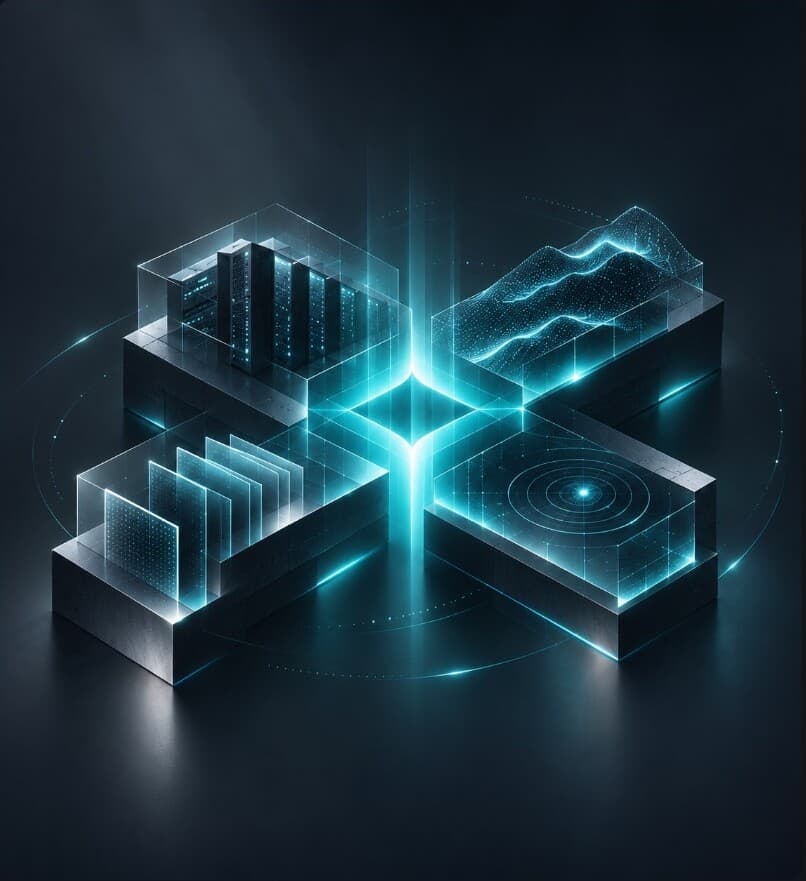
What AEGIS adds to a SIEM
AEGIS collects logs, stores them, searches them and runs rules and correlation over them, as a traditional SIEM does.
What a SIEM typically produces is an alert in a queue, and what happens next is often left to analysts, a module or another tool. AEGIS carries on.
Collection, search and detection
| Capability | A traditional SIEM, typically | AEGIS 0.3.4 |
|---|---|---|
| Collection | Collects logs and normalises them to its own schema | HTTPS push, webhooks, syslog and API pull; events normalised to 18 OCSF classes |
| Storage and search | Retention and search are the core function | An event lake searched with SQL, pipe queries and questions in plain language |
| Detection | Rules and correlation | 132 rules in production, correlation sequences, signal clusters, UEBA, beaconing and identity analytics |
| ATT&CK coverage | Often a view that maps rules to techniques | Declared, observed and validated kept as three separate states, with a Navigator export |
The middle column describes the category in general and no product in particular.
Detection and search in detail
Rules are tested before they alert
Rules move through development, test, production and retired. A rule in test records the alerts it would have raised without alerting anyone, and every move is audited.
The cause of a coverage gap
A telemetry view on the Coverage page shows whether a gap is a missing rule or a missing data source.
Search has fixed limits
Query Center SQL is read-only, limited to the caller's tenant by the event lake itself, and capped at 60 seconds and 50,000 rows. A question in plain language sends the model the question and the schema, with no event rows.
Tuning proposals list what they hide
A job proposes lowering or disabling noisy rules from how analysts closed their alerts. Each proposal lists the true positives the change would have hidden, and an admin decides.
Triage Queue
The queue lists alerts with their severity, risk and status. Each row also shows the verdict and confidence the AI reached, or how far its run has got.
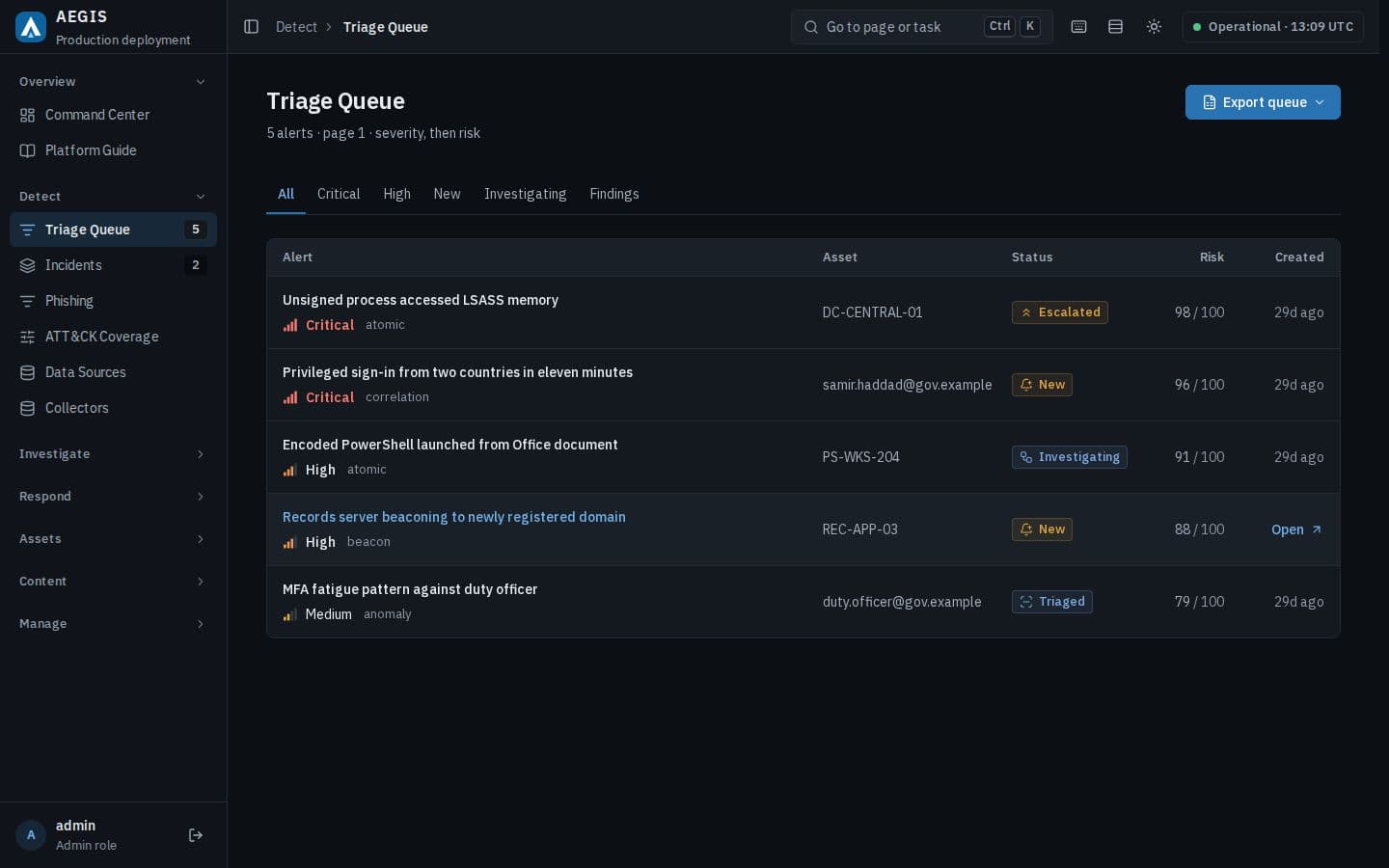
What happens after the alert
Investigate
Eligible alerts go to the AI. It returns true positive, false positive, benign or needs human, with a confidence and its evidence quoted.
Group
Alerts that share an entity within 10 minutes join one incident of up to 15 alerts, and the reason is shown.
Open
A true positive or an escalation opens a case, one per incident, with respond and resolve clocks set per severity.
Respond
A containment action passes the policy gate and, where the policy asks for approval, waits for a distinct approver. Until live response is enabled it runs as a drill.
Record
Security-relevant changes are saved together with their record in the tenant's audit chain.
Common questions
Does AEGIS take the place of our SIEM?
Yes. AEGIS does the work of a SIEM, AI triage, case management and SOAR in one product. Your Sigma rules and syslog feeds carry over, and the two can run side by side while you move.
Can we keep our SIEM and add AEGIS?
Yes. AEGIS exports its alerts, and optionally its audit records, to up to 10 destinations per tenant, as syslog in CEF, LEEF or JSON or as signed HTTPS. The Query Center can also search an existing search backend through federated search.
How long are events kept?
90 days searchable by default, configurable from 1 to 3,650 days. Hourly aggregates, which hold counts, are kept 400 days.
Can we bring our own detection rules?
Yes. Sigma rules placed in the Sigma rules folder run directly, with modifiers and Sigma v2 correlations supported. Rule files reload every 10 seconds.
What if no parser recognises a log?
The log is still stored, and its source type is listed as unclaimed. Generic CEF and LEEF from any vendor are parsed as shipped.
Read next.
Talk to an engineer
Tell us what you run today and what worries you. Someone who works on AEGIS will reply.
Get in touch