Explainers / What a SIEM is
What a SIEM does
A SIEM collects your logs, keeps them, searches them and raises alerts. AEGIS does that work, and its AI analyst investigates the alerts.
One place for every log
SIEM stands for security information and event management. It gathers logs from across an organisation, keeps them, lets analysts search them, and runs rules over them to raise alerts.
The name joins two older jobs. Security information management kept logs and reported on them. Security event management watched events as they arrived and correlated them. A SIEM does both on the same data.
The sources are whatever writes a log that matters to security: firewalls, servers, identity systems, cloud services, endpoint tools, applications.
What happens to one log line
Collect
A source sends its logs, or the SIEM fetches them. Syslog, agents on hosts and vendor APIs are the usual routes.
Normalise
A parser reads each line and puts its parts into common fields, so a sign-in from one product looks like a sign-in from another.
Store
The event is indexed and kept for a set period, long enough to investigate an attack that began weeks before anyone noticed.
Detect
Rules run over the events. A simple rule matches one event. A correlation rule looks for several events that together mean something.
Alert
A match becomes an alert in a queue.
What a SIEM is good at
Search across every source
One query can follow an address or an account through the firewall, the directory and the mail gateway. Without a SIEM that is three consoles and three time formats.
Correlation between sources
Fifty failed sign-ins, then a success, then a new mail forwarding rule: it takes a system holding all three logs to see one attack.
History when you need it
The SIEM is where the evidence still is after the source device has rotated its own logs away.
A record for regulators
Rules on security monitoring commonly ask that events are collected and kept for a stated period. A SIEM is the usual way to show that they are.
The alert queue
On its own, a SIEM's work ends when the alert is raised. Whether it is real, how bad it is and what else the account did are left to a person, or to the tools added around the SIEM.
Answering takes context the alert does not carry. The analyst runs more searches, looks up the host and checks the user's history. Each alert costs minutes, and rules raise alerts faster than people can spend them.
Tuning does not remove the problem. A rule loose enough to catch a careful attacker also fires on ordinary work, and a rule tight enough to stay quiet misses things. The queue grows, analysts sort it by severity label, and the alerts at the bottom may never be opened.
What has been built around it
Some additions are sold as separate products and some as modules.
| Addition | The gap it answers | What it does |
|---|---|---|
| SOAR | Response steps repeated by hand | Runs playbooks that enrich an alert and call other tools to block, isolate or disable. |
| UEBA | Rules only match what someone wrote down | Builds a baseline of normal behaviour for users and hosts, and flags departures from it. |
| Case management | An alert is not a unit of work | Gives an incident an owner, a timeline, evidence and a deadline. |
| Threat intelligence | Rules do not know what is already known to be hostile | Matches events against lists of addresses, domains and file hashes. |
| AI triage | Nobody reads every alert | Investigates an alert and proposes a verdict, with its evidence, before an analyst opens it. |
| XDR | Depth on the endpoint | Detects and responds through a vendor's own sensors, starting from the endpoint. |
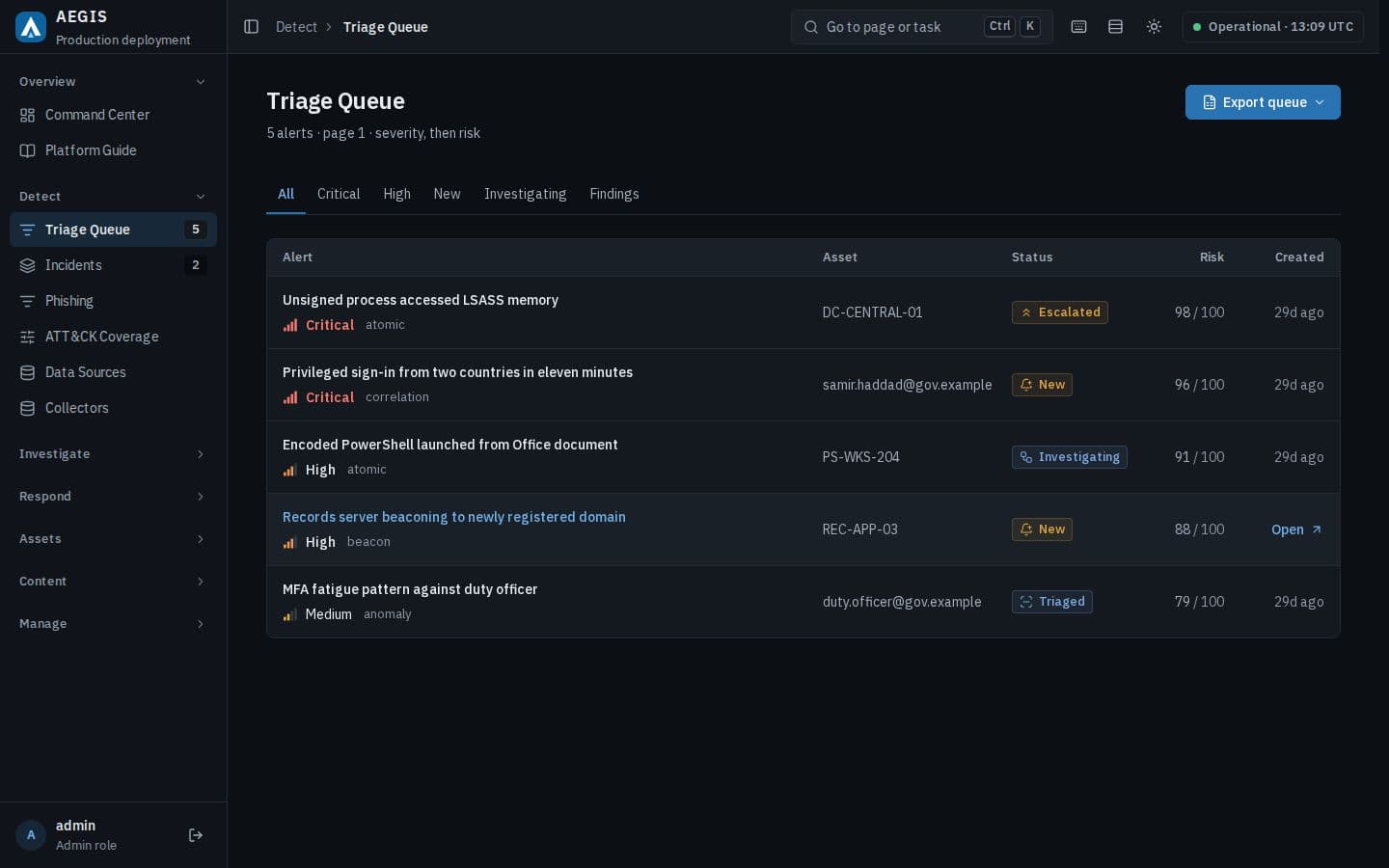
The AEGIS Triage Queue
The Triage Queue lists alerts by severity and then risk, each with the AI's verdict and confidence, or the state of its run.
Common questions
Is AEGIS a SIEM?
It does a SIEM's work (collect, store, search, detect) and adds AI investigation of eligible alerts, case management and guarded response actions. It runs as containers on one Linux server in your environment.
Can we keep the SIEM we have?
Yes. AEGIS can send its alerts there as syslog.
How long are events searchable?
For 90 days by default, and you can set anything from 1 to 3,650 days.
What does the AI do with an alert?
It investigates with read-only tools and proposes a verdict that must quote 1 to 12 pieces of evidence word for word. A true positive, or a request for a human, opens a case.
What if the AI cannot reach a verdict?
The run fails closed: the alert escalates to a person, with a case opened for it.
Read next.
- SIEM, SOAR and XDRAEGIS does a SIEM's jobs and, for four action types, a SOAR's guarded response, as one platform.
- Against a traditional SIEMAEGIS does the work of a SIEM and carries on after the alert: the AI analyst investigates the alerts, true positives open cases and response waits behind a policy gate.
- Too many alertsAEGIS queues each alert for an investigation and closes the harmless ones that pass its checks.
Talk to an engineer
Tell us what you run today and what worries you. Someone who works on AEGIS will reply.
Get in touch