Solutions / Too many alerts
Alerts reach your analysts already investigated
AEGIS queues each alert for an investigation and closes the harmless ones that pass its checks. Related alerts join one incident, and repeated events are dropped at intake.

More alerts than a shift can open
When more alerts arrive than your shift can open, the low and medium ones go unread, and nobody can say what was in them.
A suppression rule shortens the queue by hiding alerts. AEGIS has its AI analyst investigate each one and return a verdict with the evidence quoted, so your analyst reads a finding and decides.
Fewer alerts reach the queue
Related alerts become one incident
Alerts that share an entity, such as a host or an account, within 10 minutes of each other join one incident of up to 15 alerts. The incident page shows why each alert was grouped.
Shared infrastructure is left out
A DNS server or a proxy that an admin has tagged as shared infrastructure does not pull unrelated alerts together. The group reason names it.
Repeated events are dropped
An identical event repeated within five minutes, for the same tenant, is dropped before it is stored or reaches detection.
Weak signals wait until they add up
Low-confidence signal rules alert when the signals for one entity add up inside a set window.
A noisy rule arrives with a proposal
Every 30 minutes a job proposes lowering or disabling rules, judged by how analysts closed their alerts. Each proposal carries its backtest, including the true positives the change would have hidden, and an admin decides.
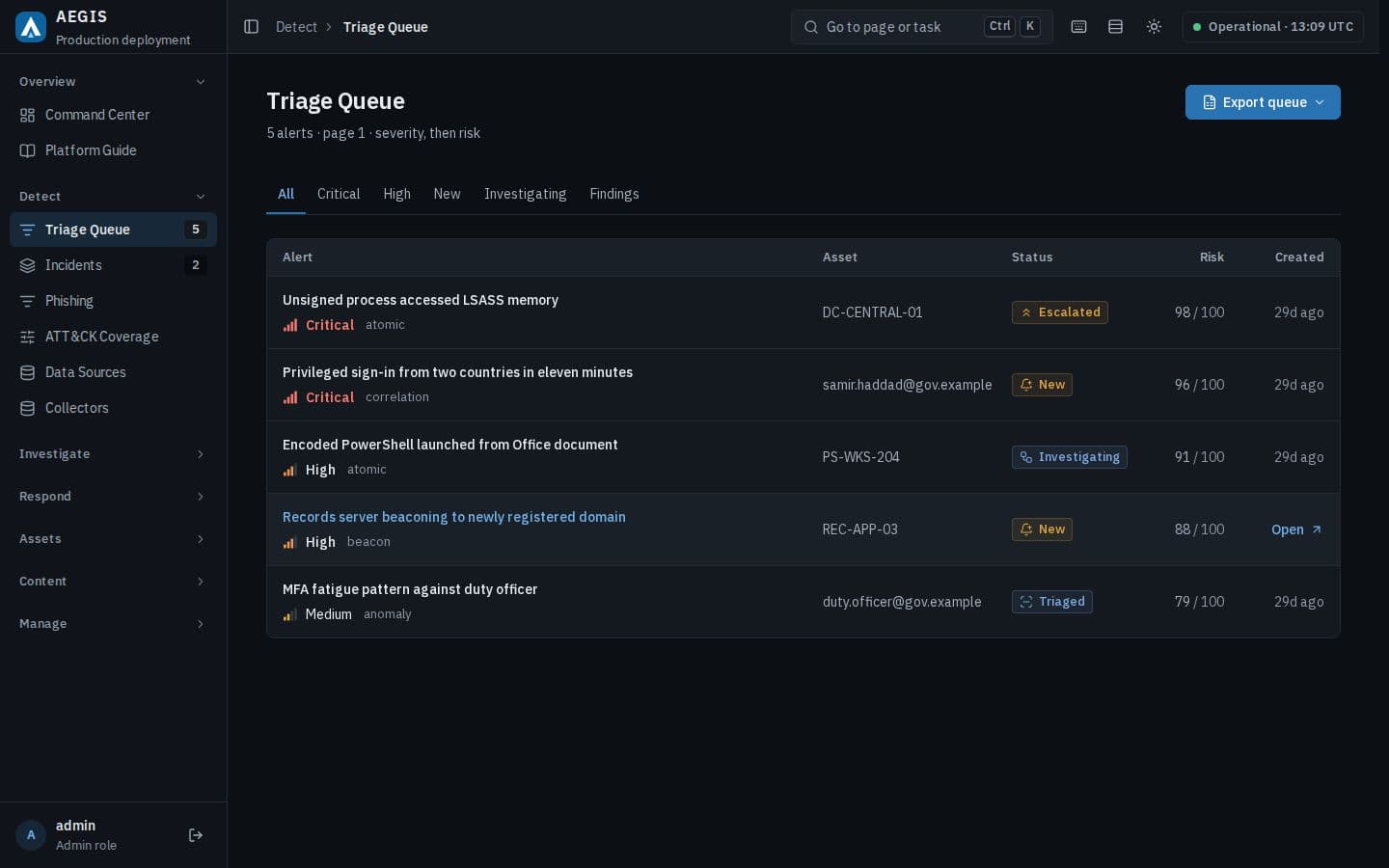
Triage Queue
Alerts are listed by severity, then risk, 25 to a page. Each row carries the AI's verdict and confidence, or the state of its run, and the number of its actions awaiting approval.
Common questions
Does the AI investigate every alert?
Every alert is queued for investigation unless you set a minimum severity. Alerts below that stay in the triage queue for a person.
What stops the AI from closing a real attack?
Its confidence must be 0.85 or higher, the severity Medium or lower, and the verdict not marked degraded, as a fallback model's answer is. A benign verdict that fails any of the three is held for a person, and 5% of the benign closures are picked at random for human review. With no valid verdict, the alert goes to a person and a case opens.
How do we see how often analysts reverse it?
SOC Performance reports the overturn rate: the share of AI decisions that analysts reviewed and reversed. The reviews happen under Needs confirmation.
Read next.
- AI analystThe AEGIS AI analyst investigates alerts with nine read-only tools and quotes its evidence word for word.
- Triage and incidentsThe AEGIS triage queue orders alerts by severity, then risk.
- Too few analystsAEGIS gathers the context for each alert and proposes a verdict, so a small team spends its time on decisions.
Talk to an engineer
Tell us what you run today and what worries you. Someone who works on AEGIS will reply.
Get in touch